Yelp ads pay off for home-service contractors when a request becomes a booked job, not when it stops at a click. The shops that convert more of those leads reply quickly, address the actual project in the first message, and give the homeowner a clear way to schedule. Here is how HVAC, plumbing, electrical, roofing, solar, and other trades can do that in markets across the US.
Why do Yelp ads create requests that never become jobs?
A Yelp ad is doing its job when a homeowner sees your business and sends a request. That is the start of the work, not the finish.
Many of those requests stall for ordinary reasons. The message sits in an inbox while the crew is on a job. The first reply is a generic "please call us" that sends the homeowner back to the start. The lead is for a ZIP code you do not serve, a job you do not take, or a timeframe you cannot meet, and nobody says so. Or the click was real and the booking was never recorded, so it is hard to tell whether the ads need work or the follow-up does.
Clicks only tell you that people are finding you. Booked jobs tell you whether the path after the click is working.
How fast should you respond to a Yelp request?
Yelp publishes its own guidance on this, and it is specific. Yelp says customers are two times more likely to respond when a service provider replies within an hour and addresses project details and questions, instead of just suggesting a call or linking to another form. Yelp also says businesses with a response time of less than a day see four times more requests than businesses that wait longer to reply.
That is not a claim that every shop will see the same lift. It is a clear signal from the platform that both speed and substance in the first reply matter.
Yelp also shows a response time and a response rate on your business page. According to Yelp, response time is the median time you took to respond to new messages in the last 30 days, not including after hours from 6 p.m. to 8 a.m., and response rate is the percentage of new messages you responded to in that window. Homeowners can see how consistently you write back before they ever send a request.
Two practical notes follow from that. First, a reply after 6 p.m. or before 8 a.m. may not change the public response time Yelp displays, but it can still decide whether you book the job. Second, Yelp says that if you do not reply within seven days of a new message and have not replied to any message in 30 days, messaging can be turned off automatically. An ignored inbox can quietly stop new requests from arriving.
If you already answered the customer by phone, Yelp still asks you to mark the message as replied so the public response figures stay accurate.
What should the first reply to a Yelp lead include?
Speed gets you into the conversation. The first message is what keeps you in it.
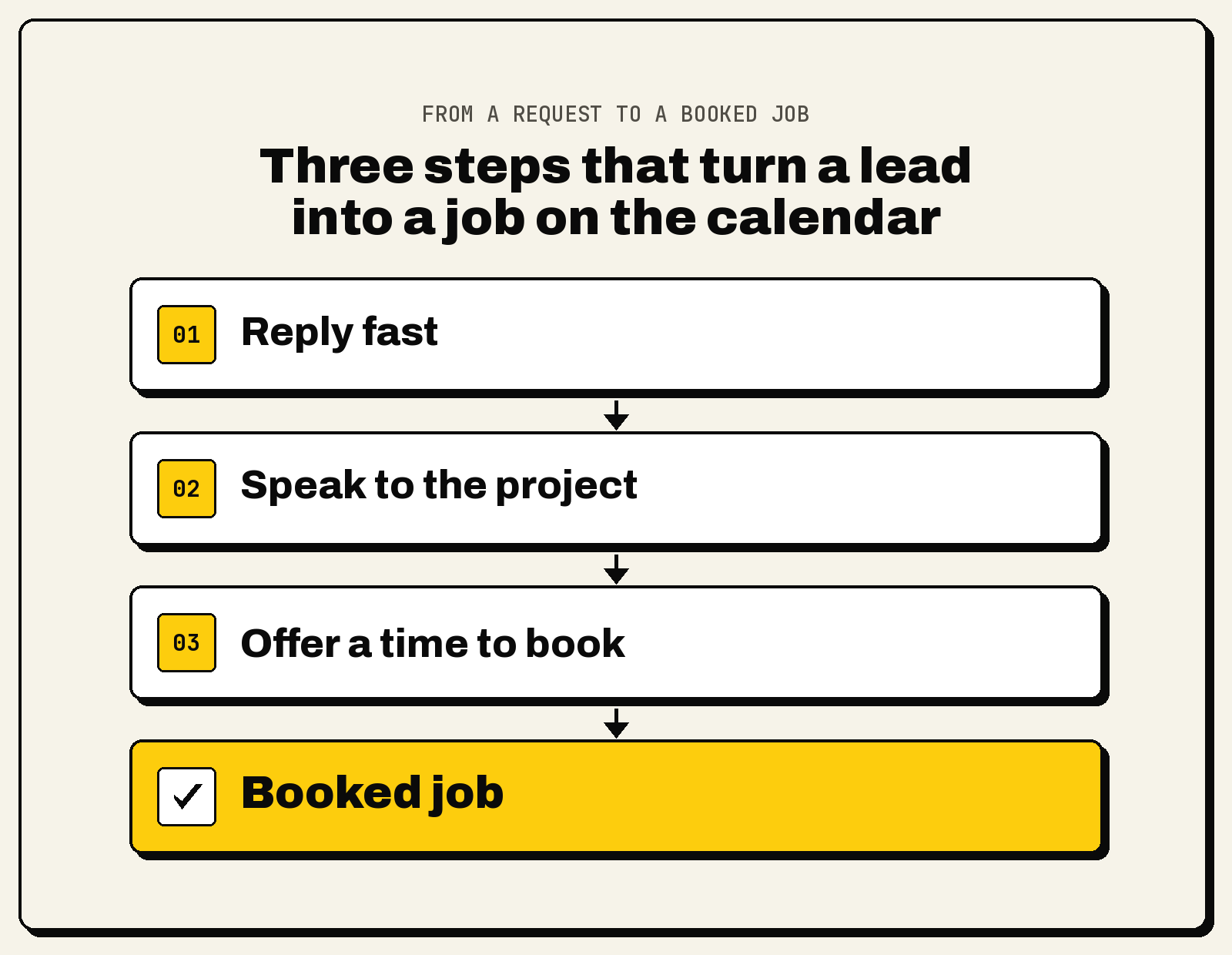
Yelp's own page-maintenance guidance tells service businesses to respond quickly, personalize the reply by referencing the details the customer already sent, include pricing information when you can, and set a clear next step. Yelp's example is the difference between "Can I come out tomorrow at 2 p.m.?" and "Call me to schedule."
A useful first reply for a home-service request usually covers four things:
- A line that shows you read the request: the symptom, the neighborhood or address, and the timing they mentioned.
- Whether you can take the job, in plain language.
- A price, a range, or an honest note that you need a short visit or two more details before you can quote.
- One or two arrival windows, and a simple way for the homeowner to confirm.
You do not need a perfect quote in the first message. You do need to remove friction. Asking someone to call a number and start over is how a paid lead becomes someone else's booking. If you cannot price the job from what they sent, say what you still need and offer a time to look at it.
Yelp's inbox gives you structured ways to do this: send an estimate and availability, ask for more information, or let the customer know you are unable to take the job. Use that last option when the work is outside your trade, area, or schedule.
How do you qualify a Yelp lead without slowing the booking?
Qualification should make the appointment easier, not turn the first reply into a long form.
The questions that matter for most home-service jobs are short: What is going on? Where is the property? When do they need someone? Is this a service you actually perform? If those answers are already in the Yelp request, do not ask them again. Confirm them, then offer times.
If a detail is missing, ask for that detail and still propose a window. "Are you in our service area, and would Thursday morning or Thursday afternoon work for a diagnostic?" moves the job forward. A list of eight intake questions with no availability does not.
Then get the job onto a calendar. A qualified lead that nobody schedules is still an unbooked lead. Confirm the address, the arrival window, and how the technician will check in, and make sure the booking is visible to whoever is dispatching that day.
How should you handle nights, weekends, and after-hours Yelp requests?
Home-service requests do not wait for office hours. A furnace that quits on a Saturday night, a leak that starts after dinner, or a same-day electrical issue will still generate Yelp requests in every region of the country.
Build a coverage plan for the hours when no one is at a desk. That can be a designated on-call person with notifications turned on, a written after-hours script, and a rule for which jobs get an emergency window versus the next open slot. Automated replies can acknowledge the request in seconds, ask the qualifying questions you care about, and hold a time on the calendar so the homeowner is not left waiting until morning.
The point is not to wake a technician for every message. The point is that the customer hears back quickly, knows whether you can help, and has a booked time or a clear plan before they message the next business.
How can you tell if your Yelp ads are producing booked work?
Watch the path from request to job, not only the path from impression to click.
Useful questions for a weekly review:
- How many Yelp requests arrived, and how many received a first reply within an hour?
- How many of those replies offered a specific next step?
- How many became a scheduled appointment, and how many of those appointments ran?
- Which requests were out of area, out of trade, or not ready to book?
Campaign structure still matters. If you are paying for categories you do not serve, or running ads at hours you cannot cover, you will get requests you cannot book. Tightening targeting and scheduling is often a better first move than raising spend. On the Therma Tech case study, a San Jose HVAC company saw about 29% lower Yelp ad costs after campaign restructuring, scheduling, and targeting work, and that result held for six months. Results vary by market.
When you review performance, use clear reporting on every lead, call, and booked job. That gives you a working picture of what happened after the request. It is not a substitute for Yelp's own reporting, and the two will not always line up line for line.
If you want help running this as a monthly service, TrafficHive is a done-for-you ads-to-booked-jobs agency for home-service contractors nationwide and an official Yelp Partner and Yelp Premium Agency. Platform fees are $297 per month for ad budgets under $5,000, $597 per month for budgets from $5,000 to $20,000, and custom pricing above $20,000, billed monthly with no setup fee. Details are on pricing.
Frequently asked questions
Do Yelp ads work for HVAC, plumbing, and other home-service trades?
Yelp is built around homeowners looking for local service providers, which is why it is a common channel for HVAC, plumbing, electrical, roofing, solar, and similar trades across the US. Ads can create the request. Booking still depends on a fast, specific reply and a clear path onto your calendar.
What is Yelp response time, and why does it matter?
Yelp calculates response time as the median time you took to respond to new messages in the last 30 days, not counting after hours from 6 p.m. to 8 a.m. A stronger response time can make your page more appealing to the next customer, and Yelp reports that businesses with a response time of less than a day see more requests than those that wait longer.
Should the first reply just ask the homeowner to call?
Usually no. Yelp says customers are two times more likely to respond when you reply within an hour and address project details and questions, instead of only suggesting a call or sending them to another form. Offer information and a time to meet, then use the phone to confirm if needed.
What happens if Yelp messages go unanswered?
Individual jobs get away, and Yelp says messaging can be disabled if you do not reply within seven days of a new message and have not replied to any message in 30 days. Turn on notifications and keep a coverage plan for nights and weekends.
How should a contractor measure Yelp ad results?
Measure booked jobs and completed work, not clicks alone. Review reply speed, whether the first message offered a next step, and how many requests became appointments. Use clear reporting on every lead, call, and booked job alongside the information Yelp already provides.
Can TrafficHive help contractors with Yelp ads?
TrafficHive is an official Yelp Partner and Yelp Premium Agency. We run Yelp ads for home-service contractors nationwide, help qualify and book the leads that come in, and provide clear reporting on every lead, call, and booked job.
If you want a straightforward look at how your Yelp ads, reply time, and booking path are working, Get a free 15-minute Yelp ads audit.
Sources
- Yelp, "What does a Yelp user look for when choosing a service provider on Yelp?" https://business.yelp.com/resources/articles/what-does-a-yelp-user-look-for-when-choosing-a-service-provider-on-yelp/
- Yelp, "Study shows high-intent consumers are contacting businesses on Yelp." https://business.yelp.com/resources/articles/study-shows-high-intent-consumers-are-contacting-businesses-quickly-on-yelp/
- Yelp, "The complete checklist for maintaining your Yelp Page." https://business.yelp.com/resources/articles/yelp-page-checklist/
- Yelp Help Center, "How do I respond to a quote request for my business?" https://biz.yelp.com/support-center/article/How-do-I-respond-to-a-quote-request-for-my-business
- Yelp Help Center, "How is the response time and response rate calculated for messaging my business?" https://biz.yelp.com/support-center/Yelp_Business_Page/Messages_Notifications/How-is-the-response-time-and-response-rate-calculated-for-messaging-my-business/en-US
- TrafficHive, "Therma Tech" case study. https://traffichive.ai/case-studies/therma-tech