
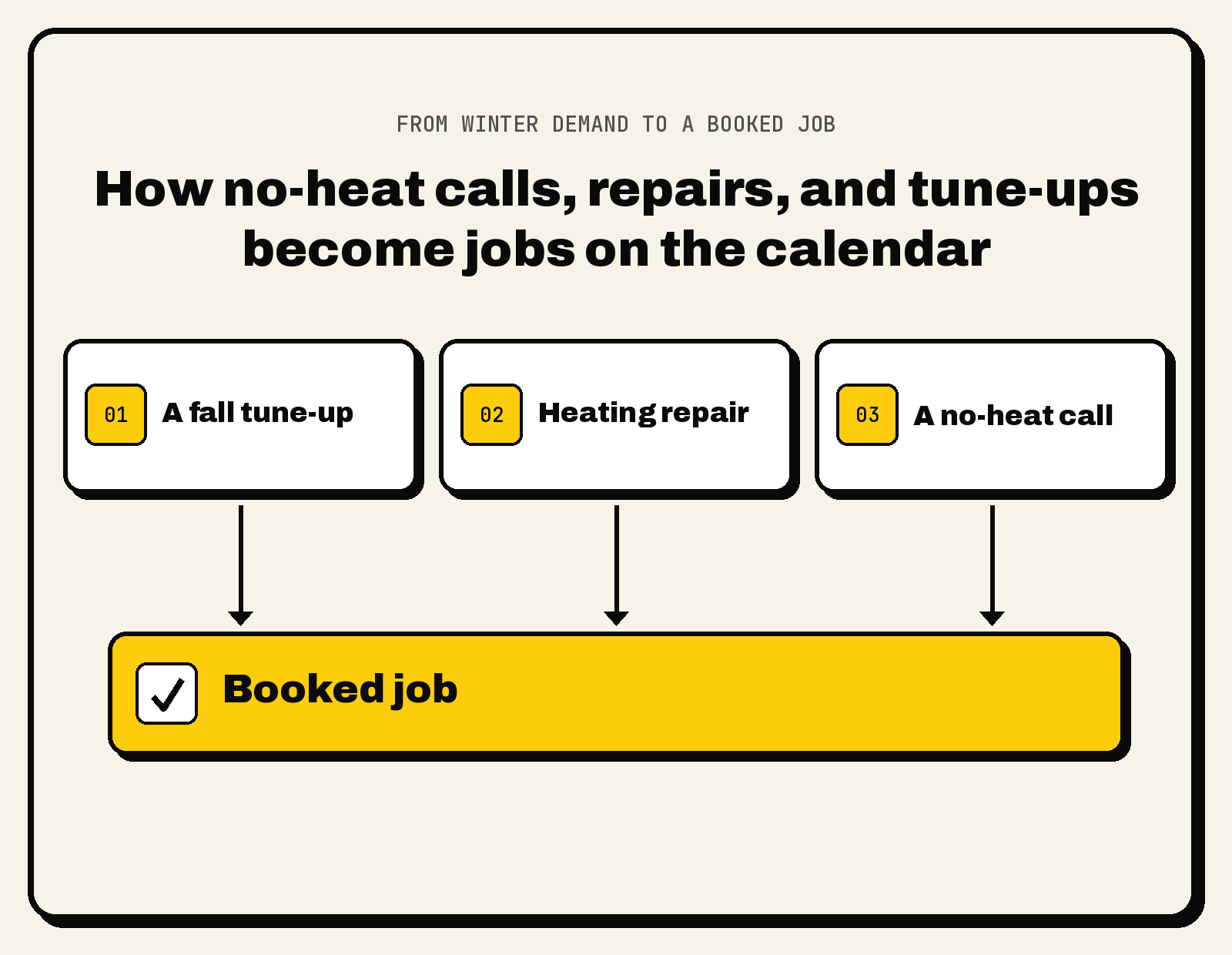
Winter HVAC advertising helps a company capture heating demand when homeowners can find the shop for the work they actually need — a no-heat call, a heating repair, or a tune-up — and when someone turns that request into a job on the calendar. In its Winter Fuels Outlook, the U.S. Energy Information Administration treats the winter heating season as November through March. This article explains how that season shows up for HVAC companies across the US, and how Yelp, Google Local Services Ads and Search, and Meta can fit the work without treating every lead the same.
Why does winter change the work HVAC companies get?
The Department of Energy's Energy Saver guide says furnaces are the most common way to heat a home in the United States, and that most are fueled by natural gas, with others using electricity, oil, or propane. EIA reports that almost all U.S. homes use natural gas, electricity, propane, or heating oil as their main heating source. In a 2025 Today in Energy article, EIA, citing 2024 American Community Survey estimates from the U.S. Census Bureau, said natural gas remained the most common main space-heating fuel, used in 47% of households, while electricity was the main fuel in 42% of homes.
That mix is not the same in every climate. EIA notes that homes in the warmest parts of the country are more likely to use electricity for heat, or to report that they do not use space heating, while propane, heating oil, and wood are more common in the coldest areas. Electricity is becoming a larger share of main heating fuel, in part because of air-source heat pumps. Winter still means heating equipment is in use nationwide, but the jobs may be gas furnaces in one market and heat pumps or electric systems in another.
EIA also notes that residential natural gas consumption is highest in the winter months because of increased demand for space heating. Residential electricity use rises in winter as well, though to a lesser extent, because more of those homes are in warmer weather with less need for space heating. Weather remains a source of uncertainty in EIA's forecasts, so winter advertising should be built around the jobs people request when equipment is in use, not around a single predicted spike.
ENERGY STAR tells homeowners to have a contractor do annual pre-season check-ups, and says contractors get busy once summer and winter come. It recommends checking the heating system in the fall. When that advice is followed, some of the winter work is planned. When it is not, or when a system fails after the season starts, the work arrives as a repair or a no-heat call.
What jobs should winter HVAC advertising cover?
A winter campaign is stronger when it covers the three kinds of heating work people actually look for, and when the ad points to services the shop can take.
Tune-ups come first for many homeowners who plan ahead. ENERGY STAR says a typical maintenance check-up should include thermostat settings, electrical connections, lubrication of moving parts, the condensate drain, and a check that the system starts, operates, and shuts off properly. On the heating side, it says the contractor should check gas or oil connections, gas pressure, burner combustion, and the heat exchanger. ENERGY STAR also tells homeowners to inspect, clean, or change air filters once a month, and says a dirty filter can increase energy costs and damage equipment. Advertising a heating tune-up in the fall and through the season gives people a reason to book before a breakdown, and it can still make sense mid-winter for homes that skipped the pre-season visit.
Heating repair is the work in between: the system is running, but not well. Uneven rooms, short cycling, unusual noise, or a unit that cannot keep up on a cold night all send people looking for help. The job may be less dramatic than a dead furnace, but it is still time-sensitive while the weather stays cold. Ads and service listings should name the repair work you actually do, including the fuel types and equipment you cover.
No-heat calls are the most urgent. A homeowner whose heat has stopped is trying to get someone to the house, often the same day, and sometimes after hours or on a weekend. Winter advertising should make it clear whether you take emergency heating calls, what area you cover, and how to reach you when the office is closed. If you cannot staff nights or weekends, say so in the way you schedule ads and intake, rather than paying for work you cannot dispatch.
Match categories, keywords, and service area to the jobs you want. A shop that does not service oil boilers or ductless heat pumps should not bid on those searches. A nationwide view of the market still means each company's ads should be local and specific.
How do Yelp, Google, and Meta fit winter heating demand?
The three channels reach people at different points in the same season. None of them replaces the others, and the right mix depends on whether the homeowner is already searching or still deciding to book a tune-up.
Yelp Ads, according to Yelp's official ads pages, are prime placements that show your business information and services to people searching on and off Yelp. Yelp says those ads can appear in Sponsored Results above and below search results, and on other business pages. You can target by location and keyword, and you can choose whether the button in the ad lets someone call, message, visit your website, or get directions. For winter HVAC, that is a natural fit when someone is already looking for a furnace tune-up, heater repair, or a company that can restore heat.
Google can cover two search behaviors at once. Local Services Ads appear when someone searches for a local service you offer, and Google says you pay for a valid lead — a call, a message, a voicemail, or, in the United States and Canada, a booking request — rather than for every click. That is useful for no-heat and repair searches, when the homeowner wants to reach a nearby contractor quickly. Regular Google Search ads can also show when people look for those same services, and are typically charged when someone clicks. Use them to cover the search terms you want to be present for, including planned work such as a heating tune-up, without treating the two Google products as the same campaign.
Meta ads reach people on Facebook and Instagram who may not be searching for an HVAC company at that moment. Meta's business help pages cover advertising on Facebook and other Meta technologies, including Instagram placements. That makes Meta a better fit for reminding homeowners that heating season has started, offering a tune-up, or staying in front of people who already visited your site, rather than as the only way to generate an emergency no-heat call. Winter demand includes both urgent searches and planned maintenance, and the channels should be assigned accordingly.
How should you turn winter HVAC leads into booked jobs?
Treat the request as a job, especially when the home has little or no heat.
If it is a no-heat or urgent repair call, pick up when you can, confirm the symptom, the address, and the timing, and offer an arrival window. If you miss the call or message, respond promptly. After-hours coverage matters in winter because equipment does not fail only during office hours. If you offer messaging or booking when no one can answer the phone, those options should still lead to a confirmed time, not an open thread.
If it is a tune-up request, the homeowner may be comparing a few companies and choosing a date. Reply with whether you can take the visit, what the visit includes, and one or two times you can be there. Confirm the appointment so it is visible to whoever is dispatching.
Then measure booked work, not inquiries alone. clear reporting on every lead, call, and booked job shows whether winter contacts are becoming jobs. It is not a substitute for the reporting in your Yelp, Google, or Meta accounts, and the two will not always line up line for line.
TrafficHive is a done-for-you ads-to-booked-jobs agency for home-service contractors nationwide, including HVAC companies. We run Yelp ads, Google Local Services Ads and Search, and Meta ads, and we help qualify and book the leads that come in. On the Therma Tech case study, a San Jose HVAC company saw about 29% lower Yelp ad costs after campaign work, held for six months. Results vary by market. Platform fees are $297 per month for ad budgets under $5,000, $597 per month for budgets from $5,000 to $20,000, and custom pricing above $20,000, billed monthly with no setup fee. Details are on pricing.
Frequently asked questions
When is the winter heating season in the United States?
The U.S. Energy Information Administration treats the winter heating season in its Winter Fuels Outlook as November through March. That is a national planning window. Local weather, and the type of heating equipment in the home, still shape when the calls actually arrive.
What should winter HVAC advertising cover besides no-heat calls?
Tune-ups and heating repair belong in the same season. ENERGY STAR recommends a heating-system check-up in the fall and says contractors get busy once winter comes. Repair searches continue throughout the cold months, even when the system has not shut down completely.
How do Yelp, Google, and Meta differ for winter HVAC work?
Yelp and Google are strongest when a homeowner is already searching for a local HVAC company. Google Local Services Ads are charged for valid leads rather than every click, while regular Search ads are typically charged for clicks. Meta is a better fit for reaching people who are not searching at that moment, such as homeowners who may still need a tune-up.
Do warmer parts of the country still need winter HVAC advertising?
Yes, though the equipment mix may differ. EIA reports that electricity is a more common main heating fuel in the warmest areas, and that winter electricity use still rises, even if less than natural gas use.
Can TrafficHive help with winter HVAC advertising?
TrafficHive runs Yelp ads, Google Local Services Ads and Search, and Meta ads for HVAC and other home-service contractors nationwide, helps qualify and book incoming leads, and provides clear reporting on every lead, call, and booked job.
If you want a straightforward look at how your ads, reply time, and booking path are working, Get a free 15-minute Yelp ads audit.
Sources
- U.S. Energy Information Administration, "Colder winter weather increases our home heating expenditure forecasts," Today in Energy, December 15, 2025. https://www.eia.gov/todayinenergy/detail.php?id=66864
- U.S. Energy Information Administration, "Electricity use is becoming more common for residential heating," Today in Energy, October 10, 2025. https://www.eia.gov/todayinenergy/detail.php?id=66324
- U.S. Department of Energy, Energy Saver: Tips on Saving Money and Energy in Your Home (2022). https://www.energy.gov/sites/default/files/2022-08/energy-saver-guide-2022.pdf
- ENERGY STAR, "Maintenance Checklist." https://www.energystar.gov/saveathome/heating-cooling/maintenance-checklist
- Yelp, "Yelp Ads." https://business.yelp.com/products/yelp-ads/
- Google, "Local Services Ads overview." https://support.google.com/localservices/answer/7549347
- Google, "How leads work." https://support.google.com/localservices/answer/7195435
- Meta, "Prepare to advertise on Facebook and other Meta technologies." https://www.facebook.com/business/help/714656935225188
- TrafficHive, "Therma Tech" case study. https://traffichive.ai/case-studies/therma-tech